Among manufacturing companies that went to the National Company Law Tribunal (NCLT), chemicals and metal firms witnessed more resolutions while companies in the labour intensive (employment friendly) leather and textile sectors mostly get liquidated, reports Abhishek Waghmare.

The size of Delhi's Budget is close to Rs 55,000 crore, or about 6 per cent of its gross state domestic product (GSDP). What set the state apart is that in the last decade, its fiscal deficit hardly crossed 1 per cent of GSDP, while many other states grappled to contain it within 3 per cent. This was largely possible due to the revenue surplus position, reports Abhishek Waghmare.
The panel may include or seek inputs from former RBI Governor Urjit Patel, former chief economic advisor Arvind Subramanian, Sajjid Chinoy of the PM-EAC, Rathin Roy, among others.

The impact of economic slump was visible in the Budget's fine print, as this step-by-step explanation show how the Budget math was worked out, reports Abhishek Waghmare.
The ministry said it was an anti-abuse provision amid growing instances of NRIs shifting their stay in low or no-tax jurisdiction to avoid tax payment in India.

The numbers become all the more important because actual tax collections fell short by Rs 1.91 trillion compared to what was projected in 2018-19. Besides, the Budget for FY20 did not give actual figures for 2018-19, but the revised numbers given in the interim Budget.

In comparison to other asset classes, globally, gold rallied significantly after many years to deliver 18.4 per cent returns in 2019.

'I suggest a cut in the GST rates and an infusion of Rs 1.2 trillion into the economy in six months.'

Measures that quickly boost demand and increase employment are needed to push up growth. Moreover, without announcing new planss, the government should strengthen schemes such as PM KISAN, MNREGA and programmes to build rural roads.

The states that witnessed high CPI-based inflation rates were Lakshadweep, Tripura, Odisha, Uttar Pradesh, Kerala, Madhya Pradesh, Puducherry, Tamil Nadu, Rajasthan, Manipur and Mizoram.
E-invoicing would be implemented on a voluntary basis by those having an annual turnover of above Rs 500 crore from January 1.

To propel demand, one should concentrate on indirect taxes and bring down the goods and services tax (GST) rates to a uniform 12 per cent as the Vijay Kelkar panel had recommended, said Ajit Ranade, chief economist at Aditya Birla Group.

The new restriction will be challenging for businesses, as they will have to do regular follow-ups with their suppliers.
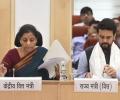
If the protected growth in GST revenue is reduced to 10 per cent, the Centre would save more than Rs 25,000 crore in 2020-21 if none of the states show any revenue growth. This would nearly amount to 0.1 per cent of the gross fiscal deficit and help the government in avoiding fiscal slippage to some extent in subsequent years.

Industry players said they were indeed seeing a serious fall in capacity usage, though some sectors were seeming to prevent further fall in the overall capacity utilisation.

Only one of the three drivers of the economy has performed in the way it should: government spending grew at 15.6 per cent, reports Abhishek Waghmare.
A look at six indicators shows all of them have collapsed from positive growth in April to contraction in September.

It shows that states would require a compensation to the tune of at least Rs 1.67 trillion in 2024-25, as none of them would be able to achieve a 14 per cent growth every year.

While experts pointed out the impact of corporation tax cuts cannot yet figure in collections as most companies are yet to decide on their choice, government officials said a part reason for slow collection is the tax cut.
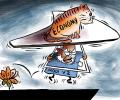
What could be the reason for the successive downward revisions across the board? Some key indicators make it evident, reports Abhishek Waghmare.
 © 2025 Rediff.com - Investor Information - Advertise with us - Disclaimer - Privacy Policy - Sitemap - Feedback - About us - Terms of use - Grievances